
Inbound Phone Call Training
Before engaging in a phone conversation, make sure to review the "How-to-Sound" page for familiarity.
Prepare a printed copy of the inbound phone call worksheet. Ensure that you have the correct version based on your store location:
Additionally, have the following tabs open in your web browser:
DealerDaily, Mitsubishi DealerLink
Dealership Websites- Scranton, Stroudsburg, Mitsubishi
Manufacturer Site- Toyota, Mitsubishi
While it might appear to be a significant amount of preparation, having these resources readily accessible will streamline your phone call navigation and minimize downtime.
Explanation of the Inbound Worksheet:
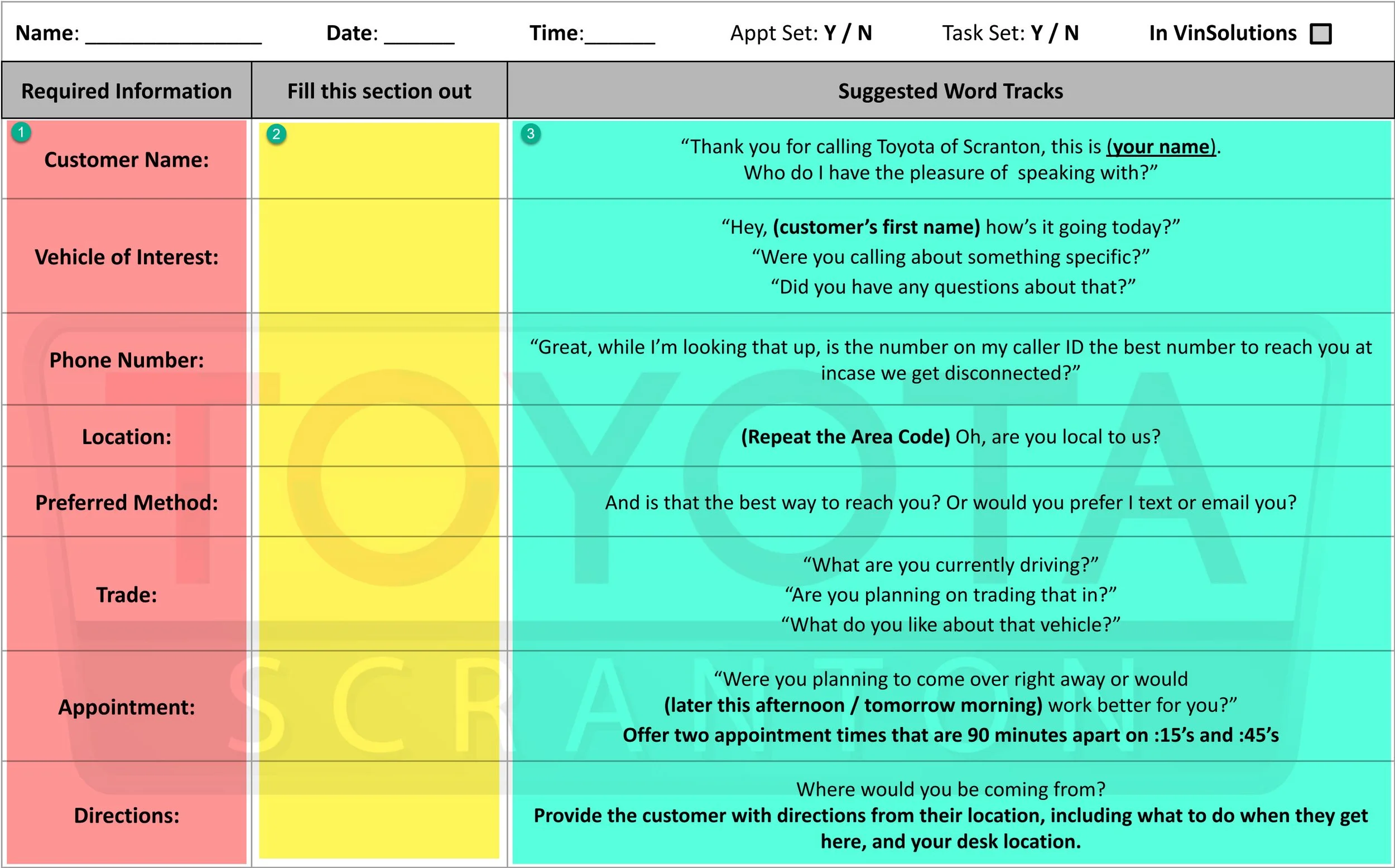
1- This is a checklist of topics you’ll want to try to cover for a complete and meaningful conversation with the customer.
2- This a designated area to jot down notes as you navigate through the call.
3- This part gives you ready-made ways to ask questions. Use them if you have trouble asking in your own words.
The primary objective of the phone call is to set an appointment with the customer. If this opportunity arises at any point during the conversation, transition directly to the appointment setting process.
Introduction:
Begin by taking a calming breath and exhaling before answering the phone. Remember not to rush through your introduction; it's important to make a good first impression.
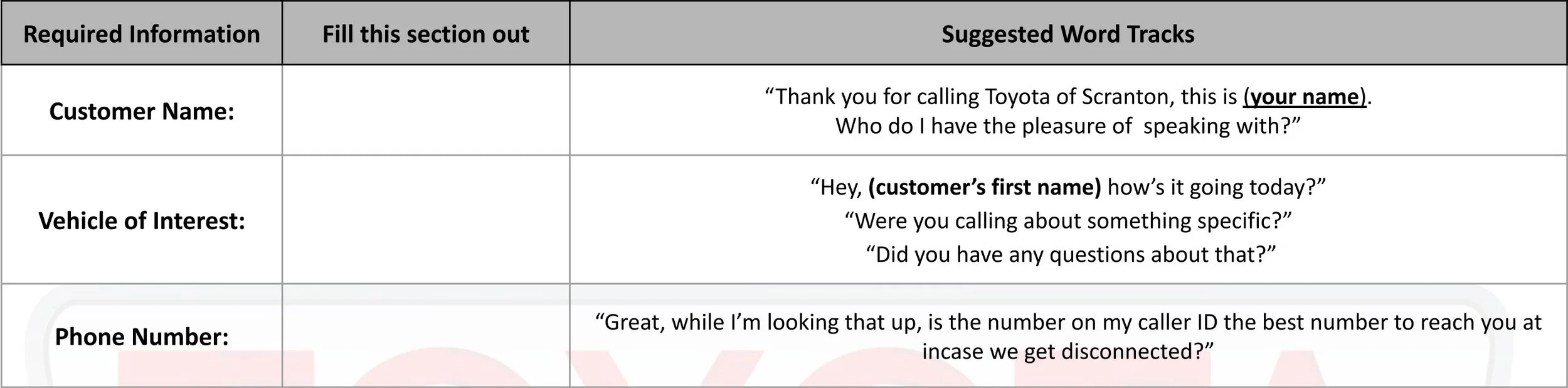
The introduction is the only part of the conversation that follows a script.
The main objective of the introduction is to swiftly learn the customer's name. Record it on your sheet and be sure to incorporate it throughout the conversation.
If you're comfortable multitasking, consider searching the Caller ID number in VinSolutions at this point. You may find that the customer is already in the system, and some of the information you would normally ask is already provided on their record.
The customer will likely be eager to share the reason for their call. Guide the conversation by asking about the customer how they are doing or ask the specific details that led them to call. While you gather the necessary information, take a moment to verify the customer's preferred contact number. Address the customer's initial queries as you work through this phase of the process. This will naturally steer the conversation. To further engage, ask guiding questions in response to the customer's requests.
For instance, if a customer asks about heated seats in a vehicle, provide an answer and conclude with a question like, "Is having heated seats a priority for you?"
Make it a point to jot down notes as you progress; these may come in handy later during the conversation or after the call.
Phone Information:
A phone number serves as a more reliable customer identifier than their name. People frequently misspell names, whereas transcribing a customer's number is less prone to errors.
Inquiring about the customer's preferred contact method not only aids in future communications but also ensures you don't mistakenly use a customer's work phone number.

Use the customer’s area code to your advantage when arranging appointments or discussing pre-sales.
If the area code is local, ask about their home location. This might make it convenient for them to visit for a test drive after work, making the suggestion feel more personal and practical.
For customers with non-local area codes, highlight the opportunity to reserve a vehicle quickly to prevent it from being snapped up by someone else later in the day. This encourages prompt action and emphasizes the vehicle’s desirability.
Trade Information:
Leveraging trade-related details is a powerful strategy to secure an appointment, particularly when the customer is in the market for a new vehicle.
When the customer inquires about specific features of the vehicle they're interested in, smoothly guide the conversation into discussing their trade-in, begin by asking whether they have the same feature in their current vehicle. Then seamlessly transition into a trade-related dialogue, incorporating questions like:
How many miles does your current vehicle have? How long have you had it? What do you like about it? What don’t you like about it?
Clarify whether their intent is to replace their current vehicle or if they're considering adding another car to their collection.

Try to gain insights into the reasons behind their initial vehicle purchase.
It's worth noting that understanding how and why a customer was previously sold a vehicle can significantly simplify your task, as you can recreate a positive experience.
Throughout this process, you can also collect important financial information to determine their readiness for a vehicle purchase and the feasibility of their financial objectives.
You can also leverage the need to inspect a trade as a way to leverage an appointment. This sounds like:
“I’d love to check out your vehicle so we can get can get a firm value for it. Would you be able to bring it over after work tonight or would tomorrow work better for you?”
By integrating these strategies, you can enhance your ability to schedule appointments and engage customers more effectively.
Appointment:
Look for an opportunity to ask for an appointment throughout the conversation. Frame the appointment as the logical next step in the customer's purchasing journey.
Consider using questions like "What does your work schedule look like?"…"Is this vehicle for you, or does anyone else need to weigh in before you pull the trigger"…"Do you happen to know your spouse's availability for Thursday, or would Saturday be a better option for both of you?" before approaching the topic of an appointment.
By discussing their schedule briefly beforehand, you can suggest appointment times that are less likely to be declined. It also provides an opening to establish rapport when discussing a customer’s personal life.

Whenever you pose questions, ensure they're phrased as "either/or" inquiries or in a manner that necessitates thoughtful responses.
When suggesting appointment times, always provide multiple options, utilizing the "15-minute/45-minute" approach. This method enhances the customer's recollection of the scheduled time and adds a sense of urgency compared to more rounded time slots like 1:00 or 1:30. While it might sound like a subtle psychological tactic, research indicates that customers tend to adhere more closely to their scheduled times when this approach is employed, resulting in better punctuality and attendance.
Directions/Conclusion:
Although many individuals rely on GPS navigation nowadays, using directions can initiate a strong conclusion. Similar to crafting a well-structured research paper, our aim is to wrap up the conversation memorably and confidently. Wrap up the conversation with a brief recap of your dialogue and explicit directions leading to your desk. Here's an example:
"Fantastic, as you exit 81, take a left at the traffic light. Continue to the right at the first junction. You'll spot us ahead on the left, past the Schiffs. Pull into the center of the building and enter through the double doors. You'll find my office on the right side, right in the middle. We're all set for your 10:15 appointment. The 4Runner you were interested in will be ready for you, and my manager will be prepared to appraise your vehicle."

If the discussion doesn't end in a dealership appointment, ensure it ends with a clear plan for follow-up or next steps forthe customer.
This line of dialogue serves as both a practical navigation aid and a strong conclusion to your interaction with the customer.
You are not done yet.
If you’ve filled out your sheet, it should look something like this.
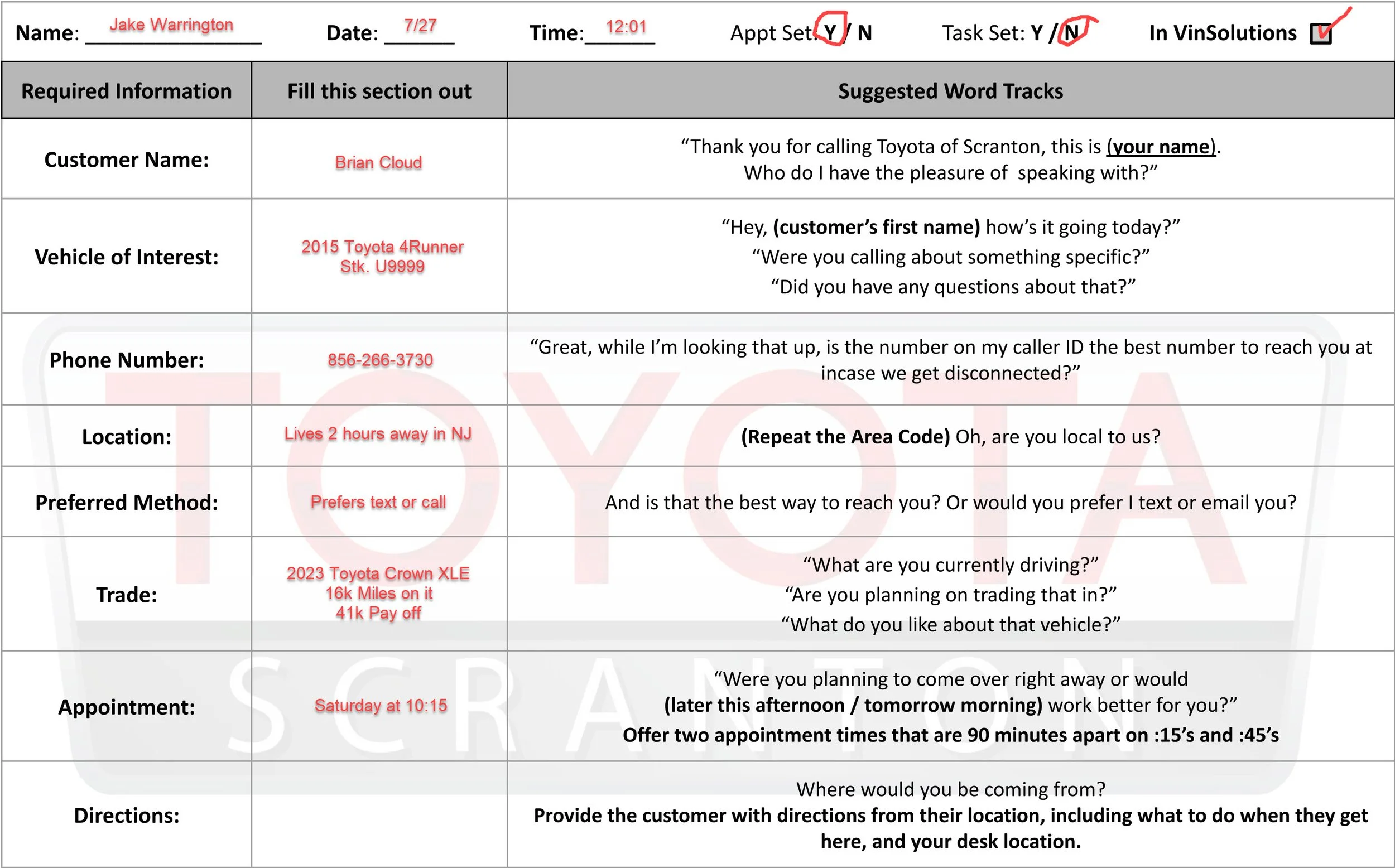
Double-check that your call is correctly recorded in the CRM system with the necessary notes. Use the worksheet to gather important customer details for clear communication. This helps build complete customer profiles. Provided are a few VinSolutions guides regarding adding a customer: