
Outbound Phone Worksheet Training
The outbound phone worksheet is designed to guide you during an outbound call. There’s no fixed order for discussing topics with a customer, as conversations can vary. The suggested phrases, or word tracks, are there to help if you’re unsure what to say. However, it's best to grasp the ideas behind these suggestions and express them in your own words, letting your personality come through in the conversation. If you find yourself stuck, these prompts are available to help you along.
The aim is to conduct a thorough customer interview while keeping the conversation casual. Frame your questions as either/or options and be prepared to address any objections. Always keep in mind that your ultimate goal is to set up an appointment or make a sale over the phone.
Understanding the Guide
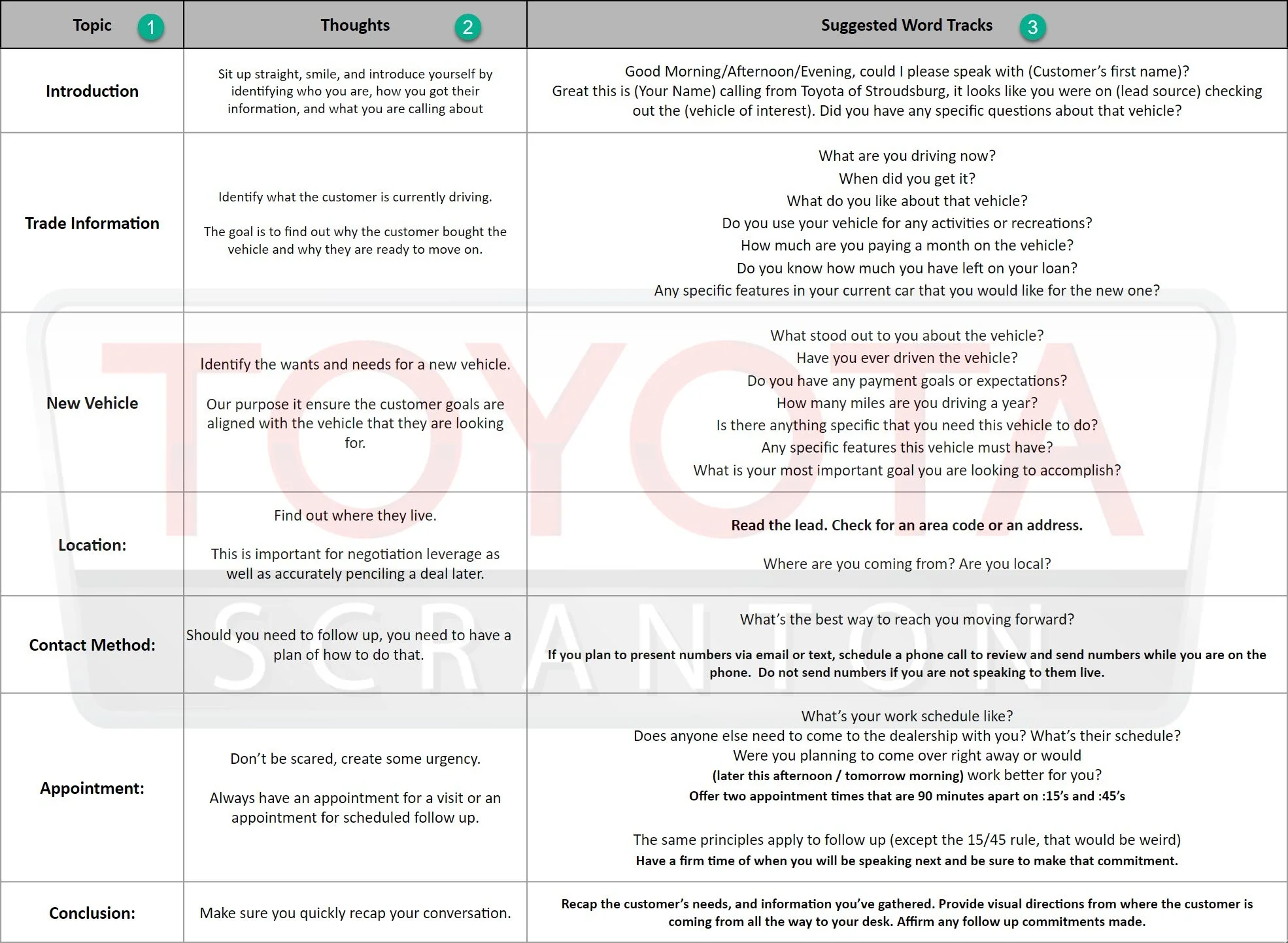
1- Topic-
Each topic should be covered during a conversation. This is what takes a quick sales pitch into a productive call for your customer.
2- Thoughts
3- Suggested Word Tracks
Introduction:
Sit up straight, smile through the phone, and slow your breathing so your introduction sounds natural.
Your goal is to create a strong introduction by clearly identifying who you are, how you received the customer’s information, and why you are calling. We want to recreate the moment when the customer first saw the vehicle online and decided to send their information to us. Achieving this quickly will help generate a greater sense of urgency and excitement for the customer. Make sure you understand your lead thoroughly so you have a solid foundation for what the customer is looking to achieve. For a list of leads and examples of introductions, please consult the Lead Source Guide.

The introduction is the only part of the conversation that follows a script.
We’re going to use this as the spring board into the customer interview.
Trade Information:
Leveraging trade-related details is a powerful strategy to secure an appointment, particularly when the customer is in the market for a new vehicle.
When the customer inquires about specific features of the vehicle they're interested in, smoothly guide the conversation into discussing their trade-in, begin by asking whether they have the same feature in their current vehicle. Then seamlessly transition into a trade-related dialogue, incorporating questions like:
How many miles does your current vehicle have? How long have you had it? What do you like about it? What don’t you like about it?
Clarify whether their intent is to replace their current vehicle or if they're considering adding another car to their collection.

Try to gain insights into the reasons behind their initial vehicle purchase. Don’t use the questions in rapid fire succession, use them as a casual next step.
It's worth noting that understanding how and why a customer was previously sold a vehicle can significantly simplify your task, as you can recreate a positive experience.
Throughout this process, you can also collect important financial information to determine their readiness for a vehicle purchase and the feasibility of their financial objectives.
You can also leverage the need to inspect a trade as a way to leverage an appointment. This sounds like:
“I’d love to check out your vehicle so we can get can get a firm value for it. Would you be able to bring it over after work tonight or would tomorrow work better for you?”
By integrating these strategies, you can enhance your ability to schedule appointments and engage customers more effectively.
New Vehicle Information:
In this section, respond to any specific questions included in the lead. Additionally, leverage the new vehicle to generate excitement and a sense of urgency about the purchasing process.
Our goal is to create an environment where the customer feels well-informed about the vehicle and can envision their future with this new car.

A crucial aspect to focus on during this part of the conversation is active listening. It’s essential to weave your personality and firsthand experiences with the vehicle into the dialogue. Doing so not only helps to alleviate any tension but also makes the new vehicle appear more relatable and accessible.
As you engage with the customer, use this opportunity to better understand their needs and objectives.
By establishing a genuine connection and demonstrating your knowledge, you'll create a more comfortable and informative environment, enabling the customer to open up about their goals for their new car.
Location Information
Determining a customer's location from a lead not only helps create conversation but also allows you to build a personal connection by discussing local features or services.
For local customers, it's important to know if they might use the service department regularly. Share this information with the desk manager. For customers who are not local, focus on setting up a remote sale. Get assistance from your internet sales manager to guide you through this process.

Use the customer’s area or zip code to your advantage when arranging appointments or discussing pre-sales.
If the area code is local, ask about their home location. This might make it convenient for them to visit for a test drive after work, making the suggestion feel more personal and practical.
For customers with non-local area codes, highlight the opportunity to reserve a vehicle quickly to prevent it from being snapped up by someone else later in the day. This encourages prompt action and emphasizes the vehicle’s desirability.
Contact Method
Although many individuals rely on GPS navigation nowadays, using directions can initiate a strong conclusion. Similar to crafting a well-structured research paper, our aim is to wrap up the conversation memorably and confidently. Wrap up the conversation with a brief recap of your dialogue and explicit directions leading to your desk. Here's an example:
"Fantastic, as you exit 81, take a left at the traffic light. Continue to the right at the first junction. You'll spot us ahead on the left, past the Schiffs. Pull into the center of the building and enter through the double doors. You'll find my office on the right side, right in the middle. We're all set for your 10:15 appointment. The 4Runner you were interested in will be ready for you, and my manager will be prepared to appraise your vehicle."

If the discussion doesn't end in a dealership appointment, ensure it ends with a clear plan for follow-up or next steps forthe customer.
This line of dialogue serves as both a practical navigation aid and a strong conclusion to your interaction with the customer.
Appointment
Throughout the conversation, look for moments to suggest scheduling an appointment, presenting it as the natural next step in their buying journey.
Consider asking questions to gauge their availability and involvement, such as, "What does your work schedule look like?" or "Is this decision just for you, or is there someone else who needs to be involved before you make a decision?" You might also ask, "Do you know if Thursday or Saturday would work better for you and your spouse?"
By understanding their schedule first, you can propose appointment times that are more likely to be convenient for them. This approach not only helps in setting a meeting but also builds rapport as you engage with aspects of their personal life.

When asking questions, frame them as "either/or" choices or in ways that require careful thought.
When proposing times for appointments, always offer multiple options and use the "15-minute/45-minute" approach. This strategy helps customers better remember their appointments and creates a sense of urgency, as opposed to more generic times like 1:00 or 1:30. Though it may seem like a minor psychological trick, studies show that this method leads to customers being more punctual and reliable in keeping their appointments.
Conclusion
While many people use GPS navigation today, giving directions can still provide a solid ending to your conversation. Just like concluding a well-written research paper, our goal is to end the discussion memorably and confidently. Summarize your conversation briefly and give clear directions to your desk. Here's an example:
"Great, once you come off 81, turn left at the traffic light. At the first junction, take a right. You'll see us just past the Schiffs on the left. Park in the center of the building and come in through the double doors. My desk is right in the middle, on the right side.
Everything is all set for your 10:15 appointment. The 4Runner you're interested in will be ready, and my manager will be on hand to assess your vehicle."

If the discussion doesn't end in a dealership appointment, ensure it ends with a clear plan for follow-up or next steps for the customer.
Double-check that your call is correctly recorded in the CRM with the necessary notes. Use the worksheet to gather important customer details for clear communication.
This helps build complete customer profiles. Provided are a few VinSolutions guides to help with the next steps in completing a customer profile: